Showing posts with label winter view 100~119. Show all posts

Oct 27, 2014

112景 目黒太鼓橋夕日の岡 View 112 Meguro Taiko-bashi Bridge and Sunset Hill

雪の降る中、人々が黙々と歩いています。
丘も木々も橋も真っ白。ただ川だけが青くて。
タイトルの赤が美しいアクセントになっていますね。

Snow is falling and everything is white, except for the blue winding river.
Red titles make a really good accent here.


この川は目黒川。
架かっているのは太鼓橋。
石造りのアーチ型の橋というのは江戸時代には大変珍しかったそうですよ。

This is Meguro River and Taiko-bashi Bridge (Taiko means a drum in Japanese).
The arched stone bridge was very unusual in the time of Edo.

この道を左(東)に行けば行人坂という上り坂。
右(西)に行けば有名な目黒不動がありました。
嬉しいことに、今もあまり変わっていません。

If you take the road to the left (east), you are climbing a steep slope called Gyonin-zaka.
If you go to the right (west), you will come to Meguro Fudo temple.
I was happy to find this area hasn't changed very much from Hiroshige's time.

これが現在の太鼓橋。

This is Taiko-bashi Bridge today.
太鼓橋 Taiko-bashi Bridge 
でも形は違いますね。 But it's not arched any more. (^_^;)

 
橋の上から見た目黒川。 Meguro river seen from the bridge

川沿いにの遊歩道と桜の木々 A pedestrian mall along the river and cherry blossom trees

行人坂を上っていくと…。

I went up the Gyonin-zaka slope.

行人坂 Gyonin-zaka slope

広重の時代そのままに、右手に大円寺があります。

Just like the old days,  Daienji temple is on your right. 
大円寺 Daienji Temple


大円寺はなかなか興味深かったのですが、ここでは二つだけご紹介しますね。

Daienji temple was very interesting. 
But I don't want to go too far.
Just two things. (^^)

1) 大円寺石仏群 Daien-ji Sekibutsu-gun
江戸三大大火の一つ、明和の大火(1772年)では死者数14700人とも言われています。
その火元がここ大円寺だったそうで。
犠牲者を供養するためにこれらの石仏群が作られたそうです。

One of the three greatest Edo Fires, the Great Meiwa Fire in 1722, killed more than 14,700 people.
It is said the fire started from this temple.
For the victims, they built these statues.   
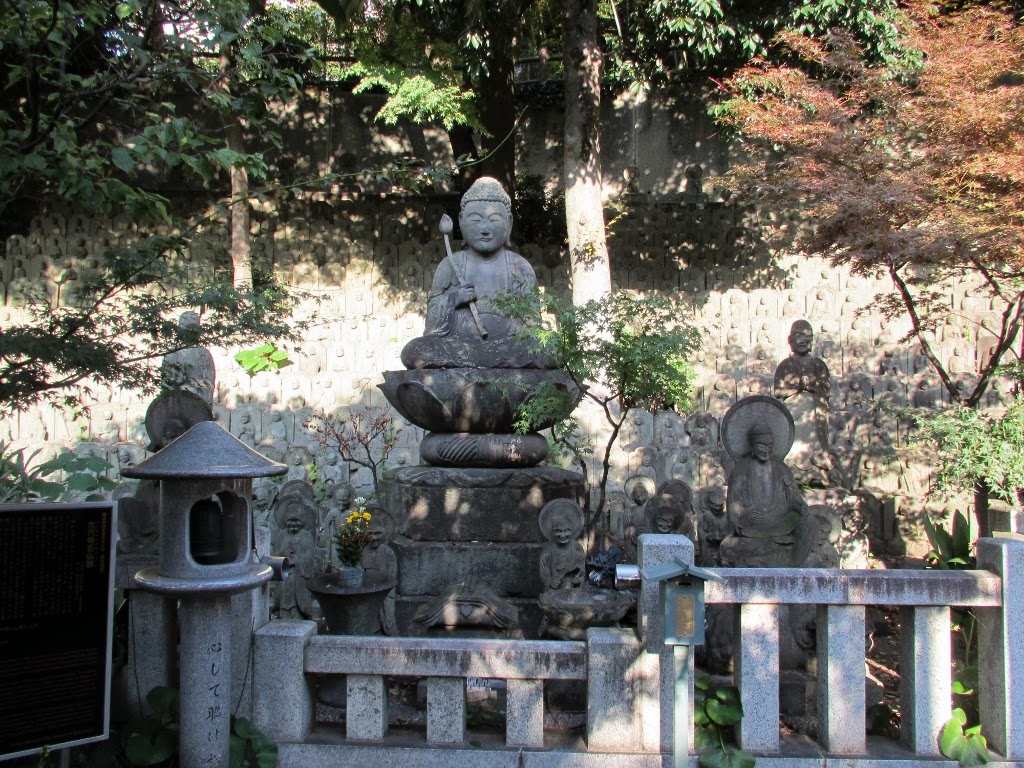
釈迦三尊、十六大弟子像の後ろにぎっしり五百羅漢が並んでいます。500 Rakan statues are behind these big statues.
それぞれ個性のある羅漢像 different face, different pose


2)八百屋お七と吉三 Yaoya Oshichi and Kichiza

八百屋お七のお話はご存知ですよね。
吉三会いたさに家に火をつけ、火刑に処せられたお七。
1683年のことだそうです。

Yaoya Oshichi is a famous girl in the Edo period.  Her sad story is so famous, even today.  It's a long story, but to make it short, she fell in love with a temple page Kichiza.  In 1683, in the hope of seeing Kichiza, she set fire to her own house.  She was caught and burned at the stake.  (for more detail, see here)
月岡芳年によるお七 Oshichi by Tsukioka Yoshitoshi (from Wikipedia)

でもその後、吉三がどうなったかご存知ですか?
吉三は西運という僧になり、諸国を行脚。
その後、大円寺の下の明王院に入ったそうです。
お七の菩提を弔うため、浅草観音まで往復およそ40キロの道のりを夜中に歩く行を1万回、実に27年5か月かけて成し遂げたとか。

Later, Kichiza became a priest with the name Saiun.
His temple, Myooin, was right next to Daien-ji temple. 
For the poor girl, he saddled himself a very hard practice of 10,000-time-midnight-walks from his temple to Asakusa temple (It was about 40 Km round trip). 
He completed it in 27 years and five months!

西運 Saiun

お七と西運のためでしょうか? Maybe for Oshichi and Saiun?

西運は江戸市民から浄財の寄進を受け、行人坂に敷石の道を作りました。あの石造りの太鼓橋も西運が作ったのだそうですよ。(^^)

Edo people respected him and donated him money. 
With the money, he built the stone arched bridge which we see in Hiroshige's print. (^^) 


さて長くなりましたが、広重の絵にもう一度戻りましょう。

Sorry, this is getting too long, but just a little bit more.

左手の小高い丘は「夕日の岡」と呼ばれていました。
今そこにあるのが目黒雅叙園です。

The hill on the left was called Sunset Hill.
Now, a famous banquet facility, Meguro Gajoen, is in the place.
目黒雅叙園 Meguro Gajoen
  
なんとなく結婚式場のイメージがあったのですが、各種
宴会、会議、宿泊等に利用できる施設です。
初めて中に入りましたが、まあその豪華絢爛なこと!

This was my first time there.
It was so gorgeous!


屋内に和風建築が建っていました。 an old Japanese style house inside the building 


夕方になると滝が幻想的 Water falls in the evening

実は雅叙園で假屋崎省吾展を見てきたのですが、それはまた次回に。

I was there to see a flower arrangement exhibition by Kariyazaki Shogo, but it's my next post.

雅叙園本当に面白かったです。

I really enjoyed the place.


さて長々とおつきあい願いましたが、ここで本日の最後の一枚、昔と今を比べてみましょう。

Now, finally, I'm ready for the final photo.  

 
目黒川、太鼓橋と雅叙園の建物。
けっこういい感じに撮れました! \(^o^)/

Meguro River, Taiko-bashi Bridge and Gajoen building...
Not bad, is it? \(^o^)/


にほんブログ村 英語ブログ 国際交流へ

Feb 24, 2014

117景 高田姿見のはし俤(おもかげ)の橋砂利場 View 117 Sugatami Bridge, Omokage Bridge, Jariba at Takada

116景の高田馬場からそう遠くない、少しだけ北へ行ったところの絵です。
手前の川が神田川。
その向こうには冬枯れの田んぼが広がっています。

This is not far from Takadano Baba in View 116, just a little north of it.
The river in the foreground is Kanda River.
Beyond the river stretch rice fields, gold with winter stubble.


橋がふたつ描かれています。
ひとつは手前の大きな橋、もう一つは中央右手に茶色い板のような橋が架かっているんですが、わかるでしょうか?
(絵をクリックしてくださると拡大できますので、よかったらどうぞ。)
これらの橋は俤(おもかげ)橋、姿見の橋と呼ばれていましたが、両者の名前はけっこう混同されて使われていたようです。
板の橋の先、左手には氷川神社、右手にはその別当寺南蔵院がありました。
砂利場というのはそのあたりの村の名前です。

There are two bridges in this print; the big bridge in the foreground, and the small plank bridge, in the center right. 
(It's really hard to see.  If you like, you can enlarge the picture by clicking.)
Their names, Sugatami Bridge and Omokage Bridge, were often confused in Hiroshige's time. 
Beyond the plank bridge Hikawa Shrine stands on the left, and Nanzoin Temple on the right. 
The area was called Jariba Village, or Gravel Pit Village.


さて、神田川に架かる橋は今もあり、面影橋と呼ばれています。

The bridge over Kanda River still remains, and its name today is Omokage Bridge.

さっそく行ってみましょう!
都電荒川線の面影橋駅で下車しますよ。

Now let's go and see the bridge.
I got off at Omokagebashi Station of Toden Arakawa Line.
面影橋駅 Omokagebashi Station
かわいい電車ですね! It's such a cute streetcar!

これが面影橋。
This is Omokage Bridge.
ごく普通の橋です。
It's just an ordinary bridge,

でもそばには案内板がありました。
except for this guide board. 

橋や田んぼの中の小道、広重の絵と同じですね。
a bridge, a path through the rice fields, just like in Hiroshige's print

橋を渡って行ってみましょう。
Let's walk across the bridge.

橋の上から見た神田川。
Kanda River seen from the bridge
両脇は桜並木。春には見事でしょうね。
There are many cherry blossom trees along the river.
It will be gorgeous in spring.

当然ですが、田んぼはありません。今は住宅地ですね。
Of course, no rice fields, but a lot of houses...


でもしばらく行くと、ちゃんと左手に氷川神社が、
Soon, I found Hikawa Shrine on the left,

右手に南蔵院がありました。
and Nanzoin Temple on the right.

すっかり変わったように見える一帯ですが、ちょっとジグザグに曲がった道も神社やお寺の位置も変わっていないようでした。(^^)

The area looks very different from the old days, but I found their location hasn't changed much. (even the zigzag  street seemed the same.) (^^)

というわけで、昔と今の写真を比べてみましょう。

Now, it's time to compare then and now.


頑張ってみましたが、この程度です。(^_^;)

This is the best I could do.  (^_^;)

あっさり終わってしまったので、少しおまけ情報を。
実は広重の立っているその後ろあたりには大名清水家の下屋敷がありました。
その一部は今も公園となって残っています。

I'm going to add some extra information of the area.
Right behind Hiroshige's viewpoint was, in Hiroshige's time, a suburban residence of Lord Shimizu.
A part of their residence still remains as a park, Kansen-en.

甘泉園公園
ここから湧く泉の水がお茶に適していたことからそう呼ばれるようになったそうです。

Kansen means "sweet spring water" and it's said its water was very good for making tea.

雪吊りが水に映ってきれい The garden was very beautiful.


そして公園の隣には水稲荷神社があります。

Mizu-inari Shrine is next to the park.


941年俵藤太秀郷(たわらのとうたひでさと)創建と伝えられています。
もとは現在の早稲田大学九号館法商研究棟あたりにありましたが、1963年甘泉園公園内の現在地に遷ったそうです。

Its history goes back to 941 when Tawarano Tota Hidesato established Inari Shrine at where Waseda University Building 9 stands today.
The shrine was relocated to the present location in 1963.
でも趣は十分ありました But they look old.


堀部安兵衛(1670~1703)助太刀の場所の碑もあります。
安兵衛が高田馬場の決闘の助太刀をして一躍有名になったのはこのあたり。
その後赤穂浪士として討ち入りを果たしたのはご存知のとおりです。

This is a monument in memory of  Horibe Yasubei(1670-1703), a samurai in Edo period.
He was a strong samurai, and became a hero after a duel in Takadano Baba.
He is one of the 47 Ronin.


この辺りにも江戸の名残をたくさんみつけることができました。\(^o^)/

So, I could find many traces of Edo in the area after all.\(^o^)/


にほんブログ村 英語ブログ 国際交流へ

Jan 8, 2014

116景 高田の馬場 View 116 Takatano Baba


ここは馬場。(午年のスタートにぴったり? \(^o^)/)

This is "baba," which literally means "horse place."
(Good start for the year 2014, the year of the horse, don't you think?  \(^o^)/)

江戸には何か所も馬場があって、そこでは馬術や弓術の練習が行われていました。この高田馬場は1636年に家光の命により築かれたそうです。

Baba is a military training ground for samurai, where  
they practiced horseback riding and archery.
There were many such grounds in Edo, and Takatano Baba was one of them.
It was made in 1636, by the order of the third Shogun Iemitsu.


下の絵でなんとなく全体のイメージがおわかりいただけるでしょうか?

The picture below might give you a better idea of the place.
松の生えた土手の向こうが弓術の、そしてその向こうが馬術の練習場。
Over the mound in the middle, are the archery field and the track.   

さて、そういう目で広重の絵をもう一度見ると、広重は土手の上からこの絵を描いているようですね。
手前に大きく松と白い的を配し、その向こうに馬で駆ける侍、遠くには富士山が描かれています。

Hiroshige is probably standing at the mound.
He drew the pine tree and the white round target in the very front,  and two samurai on the horse in the middle distance, and of course, Mt. Fuji in the far distance.

馬場は明治になって廃止されました。
でもその名前は高田馬場駅という駅名に残っています。

The riding ground was closed after the Meiji Restoration. 
But it gave its name to a train station "Takadano Baba."  


さて江戸時代の高田馬場は東西に長い長方形でした。
現在も、その地形はかなり残っています。
(下の地図の赤丸の中の長方形らしきところがそれです)

The riding ground was a long rectangle that stretched east to west.
We can still recognize its shape on today's map.
(It's in the red circle on the map below.)

さて馬場のあったあたりへ行ってみましょう。

Let's go and see the place. 
なるほど道がまっすぐですね。

Yes, the street is very straight.

でもそこは家やお店が立ち並んでいて、馬にかかわるようなものは何もありません。(T_T)

But it was filled with houses and shops.  No horses.(T_T)

でもそこから少し南に歩けば…

But if you go a little south...
馬の像です!

Yes, I found a horse!

ここは穴八幡宮。

It's in Ana Hachimangu Shrine.


穴八幡宮は弓矢の守護神。
江戸時代には代々の将軍が流鏑馬の神事を奉納しました。

It's a shrine for god of archery.  
In the time of Edo, it enjoyed Tokugawa Shoguns's favors. 
Each Shogun held Yabusame ceremony once in their reign there.  (Yabusame is a ceremony of mounted archery. )

今も年に一度10月に流鏑馬が行われています。
というわけで、昨年見に行ってきました。(^_^)v

Today, the shrine holds Yabusame once a year, in October.
Last October, I went there to see it. (^_^)v

現在は近くの戸山公園で行われています。

These days, it's held at nearby Toyama Park.
都立戸山公園 Toyama Park
It says Takadano Baba Yabusame.

流鏑馬はこんな感じ。

This is Yabusame.
約200メートルの馬場を馬で疾走しながら、3枚の的を順に射ていきます。
両手を放して馬に乗るだけでも、すごく大変そうなのに、それで的を射るなんて。

They shoot three wooden targets as they run 200 meters on horses.
It didn't look easy, controlling their horses only with knees, and shoot. 


的に当たると、的はぱりんと割れます。

If they hit the target, it breaks in two.
 決定的瞬間を撮ることができました! I'm so proud I got this shot!

短いですが、録画もしてみました。

I also have a very short film. 

3枚の的をすべて見事に射抜くことができた人が一人。
ご褒美の白い布を恭しく肩にかける所作も美しくて。

One of them successfully hit all three targets.
And he got his prize, a white cloth.  
He received it with grace.


初めて見ましたが、とても面白かったです。

It was such an interesting event.


というわけで、今日の1枚はこれです。

So, this is the photo of the day. 

広重の絵の場所から少し離れていますが、ご勘弁を。(^_-)

It's a bit off from Hiroshige's viewpoint, but I hope you won't mind. (^_-)

にほんブログ村 英語ブログ 国際交流へ